
Conference: Eldercare Services in Europe

International Conference:
„Eldercare Services in Europe – Home Care, Family Support and Domestic Services for Older People“

15th - 16th September, 2011 in Berlin 


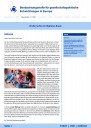
On 15.-16.09.11, the Observatory for Sociopolitical Developments in Europe in conjunction with the German Federal Ministry of Family Affairs, Senior Citizens, Women and Youth (BMFSFJ) held an international conference in Berlin on the subject of “Eldercare Services in Europe – Home Care, Family Support and Domestic Services for Older People”. Over the two days, the conference brought together a total of 175 experts from politics, administration, civil society and academia who had travelled from 15 different European Union Member States and Turkey to find out about “Eldercare Services” in Germany, the individual EU member states and at European level and to discuss European examples of good practice and undertake networking.
In the opening address, Dieter Hackler (BMFSFJ) described how the German government has further developed the statutory provision of home care, family support and domestic services in recent years through improving tax deductions. In addition, he explained that support services allow families and informal carers in particular more say over their time and thus can contribute to an improved reconciliation of work and care. In the general overview provided in her presentation, Halina Potocka (AGE Platform Europe) commented on how support services for older people are discussed at the European level in the different political processes. First and foremost, she looked at the processes within the EU 2020 Strategy, as well as the consultation on care periods launched by the European Commission. In a review which compared countries, Werner Eichhorst (Institute for the Study of Labour) introduced a selection of examples of good practice in EU Member States which were then discussed – in greater detail in some cases – at six workshops. At parallel workshops on the first day, the issue was the role of the state, companies and service providers and service users as players in eldercare. The workshops on the second day dealt with social and technical infrastructures, support schemes and vouchers and communication technologies which support the provision of certain services or facilitate them in the first instance. In the concluding discussion, the various delegates came together again to review the two days, which had been packed with information, stimulating ideas and discussion: Home care, family support and domestic services are essential for those involved and make it easier to combine work and caring. The European comparison shows that there are different opportunities for improving the quality of life of all those involved, but especially of users of services. The task now was to analyse the extent and range to which the various solutions are transferable to the different member states.
A report on the conference is being drawn up at present and will be sent out to conference participants, but will be also available on the website of the Observatory.

Contact:

Annette Angermann
Policy Officer                                                              

Observatory for Sociopolitical Developments in Europe
(Project Team Berlin)

German Association     
for Public and Private Welfare

Michaelkirchstraße 17/18
10179 Berlin - Germany
Phone +49 (0)30 - 6 29 80 - 135,  Fax +49 (0)30 - 6 29 80 - 140
e-mail: angermann(at)deutscher-verein.de